couture sewing, creating designer trim, Drafting Patterns, French Jackets

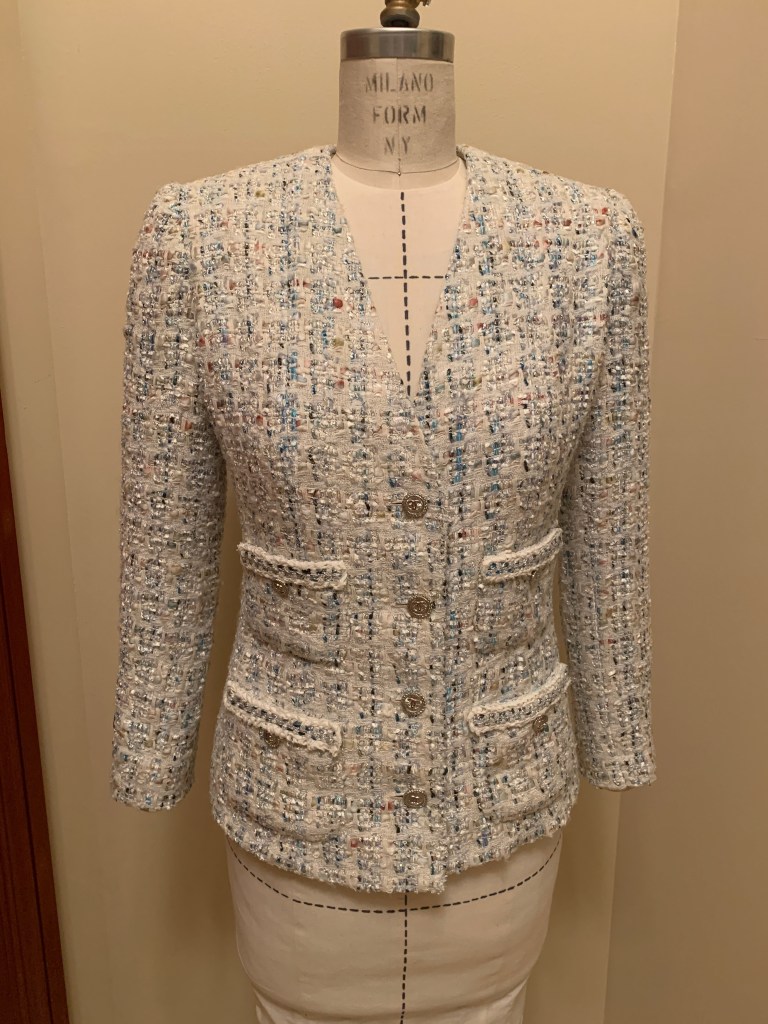
Cropped French Jacket with Matching Sheath Dress

The creation of this ensemble required much more problem solving than might appear. The fabric is a lovely designer boucle from Mendel Goldberg Fabrics and the contrast color stripes, both vertical and horizontal, presented a challenge in matching.

I constructed the sheath dress first. The darker navy stripe looked too dominate when placed on the center front. A better placement was to have the more muted blue stripe at center front. Placing the same at center back resulted in two dark navy lines next to each other along the side seam which didn’t look so wonderful. The solution was to move the center back just slightly and also shift the side seam towards the back.

The jacket was to be just below the waist with 3/4 length sleeves. My goal was to have the dominant stripes line up when the jacket and dress were worn together. A classic French jacket design has princess seams ending at the shoulder. While cutting the fabric as per the pattern fit my client’s custom padded mannequin, the extreme mismatch of the fabric design wasn’t so great.

My customary way of dealing with this is to shift the princess line closer to the neck and use steam to manipulate the fabric into shape. Anyone who has taken a French jacket class with me has experimented with this technique. Unfortunately, the fabric just wouldn’t cooperate. This boucle was mostly cotton, which doesn’t yield as easily as wool, to heat and steam. I might have been able to get away with putting in a dart, but the converging lines on the upper chest didn’t look great.

What worked best was to rotate the princess seam into a horizontal bust dart. I created a new princess seam which was shifted closer to the side seam and away from the bust point. Waist shaping was incorporated into the seam. Cut along the new seam line. The part of the dart closest to the side seam can be joined while the remainder of the dart forms what’s known as a Dior dart. Apply the same alteration to the back pattern by relocating the princess seam to start in the armseye. Waist shaping gets moved to the new seam lines.

Finished result of all this careful pattern work and attention to stripe placement. Vertical lines on both the dress and jacket match!! I was careful to place the horizontal pink stripes away from the fullest part of the bust. The Dior dart was also placed midway between two pink horizontal stripes so not not to appear awkward when sewn. Keeping the spacing between pink stripes consistent between the dress and jacket also needed to be taken into consideration. It probably looks effortless but if you’ve ever matched plaids, know otherwise.

The lining is a Pucci print chiffon underlined with pink silk crepe de chine. Yes, the lining was underlined. The chiffon print was such a perfect compliment to the boucle it had to be used but too transparent to hide the inner construction. Interestingly white underlining didn’t make the chiffon as opaque as a light pink.

Finishing details were handworked buttonholes with the reverse side of buttonholes finished with very narrow faux bound buttonholes. I used a variety of coordinating yarns plus a few fibers pulled from the boucle yardage as trim.

So much thought went into the creation of this and my client is thrilled with the result. Thanks for reading.

French Jackets, Uncategorized

Testing the Limits of Ironwork

Manipulating and shaping fabric using heat and moisture is frequently used in tailoring. Rather than using seams to create shape the fabric is molded to shape with an iron, referred to as “ironwork” in the tailoring world. I’ve experimented with this technique for quite a few years. Here’s a link to my first post describing the process.

I incorporate this in my French jacket classes to eliminate the pattern mismatch along the princess seam lines. Vogue 7975 is frequently used as a starting point when constructing a French jacket. It has minimal ease and princess seams which extend from shoulder to hem, allowing plenty of opportunity for fit adjustments.

Many of the boucle fabrics used in making these jackets have a definite horizontal pattern. When the fabric is cut according to standard procedure, a mismatch of the horizontal lines is obvious along the princess line, especially the upper portion of the front from bust apex to shoulder.

I wanted to see how far I could push the ability to shape fabric and eliminate this mismatch. Many fitting demos are done on a standard dressform which is shaped more like a runway model than that of the average body. The difficulty increases as you fit more curvy figures and the fabric is required to mold to that curvy shape. Why not increase the bust curve of a mannequin and see what happens? Here’s a standard dressform wearing a fuller size bra which has been filled out with bust pads. Let’s see if I can get the fabric to mold to this very curvy shape.

I started with Vogue 7975 in a size 10 which was the best fit for this figure’s shoulders but much too tight in the bust. Using a larger size which fit the bust would have been massively too large in the shoulders, and a much more difficult alteration. Also, standard patterns are drafted for a B cup size so while the bust circumference increases, so do the shoulders and upper body. Compare the two patterns: Vogue 7975 on the left and the corrected pattern on the right.

The shoulder width on both patterns is the same but notice the much larger bust apex to shoulder dart is wider for more shaping. Increasing the dart width while maintaining shoulder length pushes the dart (shown in red) closer to the armseye. I don’t like the look of the princess seam placed that close to the armhole, so rotated the dart (shown in black) closer to the neck edge. Now let’s see what happens with the horizontal pattern found in many fabrics.

Photo on the left shows my pattern with horizontal lines drawn as the fabric would be cut in a standard layout. Middle photo demonstrates how those lines intersect along the seam line when the dart ending mid-shoulder is sewn. The lines don’t match and start to slope upwards. Try the seam placed closer to the neck. It’s a little better but still not a great look.

What would happen if I manipulated the princess seam on the side panel into a curve and forced the straight grainline to follow the curve? Start by moving the upper portion of the side front panel to curve towards the armhole. The fabric will start to bubble up where it wants to form a bust dart. Working carefully so you don’t press creases into the fabric, steam and compress the fibers into a curve. Keep the shaping along the lower armhole and where a horizontal bust dart would be placed. Most boucles are loosely woven and will tolerate an impressive amount of manipulation. In the right photo see how much I’ve been able to curve the fabric. Work slowly. The most common mistake students make is to try and compress too much at one time. You can always curve more but it’s very, very difficult to remove an unwanted crease.

Comparison between the left side which has been shaped and the right side which has been cut and sewn according to the original pattern. Horizontal balance lines thread traced in black are helpful when fitting.

Side views of both methods. The fabric is distorted in the underarm area but much of that will be hidden once the sleeve is in. I think it’s more important to have a clean, uninterrupted look across the upper chest.

I’ve also experimented with decreasing the dart width and incorporating the needed shaping in an armhole dart but prefer the look obtained by shaping the garment sections.

Another modification that larger busted shapes find flattering is a V neck. The vertical lines created by the V tend to visually slim the figure. It’s easy to change the neckline. I have students start with the jewel neck and place a ribbon/drafting tape along the front to determine where the V should end. It can be placed higher or (if you plan to wear a blouse or camisole under the jacket) lower for a more vertical line. The jacket often looks better with a small shoulder pad. Here’s one taken from a RTW Chanel jacket.

This extreme shaping does require judgement when choosing fabric. Boucles such as these are:

1. Loosely woven which gives space to compress the yarns closer together

2. Have subtle horizontal lines or relatively solid color

3. Not too much metallic or other yarns which don’t react will to heat and steam

If you will be incorporating a great deal of shaping, use caution with fabrics that have a large obvious check, sequins or large amount of metallic yarns. The fabric on the right is mostly cotton with a tight weave. A student brought this to class. It wasn’t behaving so we split the jacket front into 3 panels, so each panel required less shaping.

Join me in Palm Beach Gardens to learn more about this technique. I’m also offering a variation of the French jacket: The Couture Boucle Bomber. It’s a more casual look, looser fitting and requires about 3/4 yard of boucle; great stash buster! We’ll add contrast fabric or leather sleeves, ribbing and loads of fun embellishment. Details coming soon.

creating designer trim, French jacket trim, French Jackets, Uncategorized

Zoom Trim Classes

Interested in learning how to create custom trims to perfectly match your fabric? I’m offering several classes via Zoom in which we’ll explore various ways of creating trim. I developed these techniques after becoming frustrated with trims available in shops. Much of what I found was too thick, stiff and not the right colors to look like couture quality.

The classes offered on March 21 and April 11 will demo basic crochet stitches and we will create at least 6 different trims using a variety of techniques. Although I will go through all the stitches needed, you will enjoy the class more if you have a working knowledge and some practice with crochet.

Kits with crochet hooks are available if you wish to use the same materials I’ll be working with. Kits WITHOUT hooks are also available if you have hooks in sizes C, D, E and F. Purchase of a kit is not mandatory. You can source your own materials and use them along with the class. Classes are recorded and you will have one week to download the recording which you can then watch as often as you like.

I’m also offering a couture trim class on May 2. This class will focus on more complex trims using better quality fabrics and yarns. The trim kit for this class includes fabric from Mendel Goldberg and Linton Tweed plus many yarns sourced from Europe. Link for the trim kit WITHOUT hooks for those who have crochet hooks in sizes C, D E and F. You will enjoy this class if you are familiar with crochet and are comfortable working with trickier (slippery, multiple strands, metallic) yarns. You can also source your own fabrics/yarns and use this class as inspiration for creating your own versions.

Several of the trims utilize a set of brass tubes I’ve developed to facilitate trim making. I’ll demonstrate their use during class. Not all trims require their use. If you have a set, have them handy as they do make many aspects of trim easier.

I recently returned from a trip to London and was able to take photos of new Chanel trims in the Chanel shop (largest in the world) there. I’ll be showing images of trims I saw and we’ll explore how to recreate these designs for your fabrics.

Class dates are linked to registration. You may also browse the class offerings in the shop. Thanks for reading and hope to see you in class.

French jacket trim, French Jackets, Uncategorized

Jacket Trim

Finding trim for your French jacket is easier when you are working with a multi color fabric, especially one with black, white or another neutral color. I think finding something pre-made for this color would be near impossible. You could introduce a contrasting color but often that’s not what you want.

Here’s a step by step tutorial on the process I used for this trim. If you’ve taken one of. my Zoom trim classes, much of this will be familiar. I used a silver metallic yarn for the base of the trim. Using a D hook, chain the desired length. Turn and make a double crochet in the fourth stitch from the hook. Chain 1 stitch. Repeat this pattern (double crochet, chain 1) in every other stitch.

If you make several lengths of trim, be sure to be consistent in which side you choose as the “right” side. Some trims look better when one side vs. the other is used as the “right” side. For this jacket, I used the side with the purl stitches for the right side.

I used the shiny yarn with variegated shades of teal. Some yarns can be pulled through the fabric. This one didn’t pull easily, so I cut closely along each shiny yarn and pulled it out. Tie the strands together and work a chain stitch along the long edges of the metallic base. To determine number of stitches needed, I make a sample using 25 stitches. Measure the sample and multiply number of stitches by the desired finished length. This jacket required 600 stitches for a length of trim which would go around the hem, along front edges and around neck. The trim for the sleeves and pockets was worked as another piece.

The trim is uneven and needs to be steam blocked into shape. I used the third from the largest tube from the Trim Tube set. Weave the tube in and out between stitches and steam. Hover the iron over the trim; you don’t want to compress it. The tube is 12 inches long so steam 10-11 inches at a time, let cool, and weave the tube through the next section. The ends where the teal yarn has been tied together will be tucked underneath when stitching to the jacket.

Stitch the trim in place. It works best to sew the outer edge around corners, then work the trim in place along the inner edge. The join between lengths of teal yarn can be tucked to the underside. The trim is very flexible and easily navigates curves and corners. I join the trim at the left hem.

When you’ve determined where to join the ends, press hard to flatten only the trim which will be turned under. Use a tailors clapper to flatten the trim as much as possible and let cool. Turn the ends under and stitch. The join will be almost invisible.

To create a finished end (nice on pockets and the sleeve vent), measure the finished length needed. Starting along one long side (it’s harder to stop and start at a corner) make the chain stitch with teal yarn. To turn the corner, make two chain stitches in each corner. One stitch for the long side and one stitch for the short end. Make 1-2 stitches across the short end of the trim. Then two stitches in the next corner. When you reach the starting point, pull yarn to the underside and fasten with a few small hand stitches. To secure the metallic yarn, machine stitch across a few times, compress the end with steam and cut off close to the stitching. The flattened end will turn under.

I will be offering additional trim classes via Zoom. Probably one in December and more starting in January. There are also a few openings left in the January class if you would like to work in person. We’ll be doing a variety of projects in the class: pattern drafting, French jackets: both starting one and completing ones already begun, dressforms and more.

My trim classes have sold out quickly in the past, so leave a comment if you would like advance notification of the schedule. Have fun creating your custom trims.

Cloning Designer Garments, couture sewing, French jacket trim, French Jackets, Uncategorized

New Classes Open

Registration is open for classes in Palm Beach Gardens. Join the 7 day French jacket class from Monday, November 7 through Sunday November 13, 2022. These jackets involve considerable hand sewing and do take time, so expanding the class to 7 days made sense.

What is unique about this class? We will start with fine tuning the fit of your jacket toile. Detailed instructions will be sent several weeks prior to class.

Vogue 7975 is often used as the basis for a French jacket. It is easy to change the jacket’s length, neckline, sleeve and front closure. The pattern has princess seams ending in the shoulder which simplifies many fitting issues. Curvy figures need more shaping which can result in any horizontal stripe in the fabric to be mismatched along the upper part of the front princess seam. This photo shows the difference.

The right side (right side of photo) of this sample has been cut and sewn according to the pattern. For the left side, I’ve made some simple changes to the pattern and shaped the front side section with a steam iron. Note how the horizontal lines in the weave carry across the upper chest uninterrupted.

We will examine techniques to eliminate darts. For this sample, I wanted a very curvy figure, easily accomplished by a bra filled out with extra padding. It’s easy to achieve the look on a small busted model but harder when dealing with more curves.

The pronounced curves of this figure required additional shaping which could have been accomplished by adding a dart either from armhole to bust or side seam to bust.

Either dart placement isn’t ideal and will create unnecessary bulk. Fortunately most boucle fabric is pliable and can be molded with steam. Any distortion in the weave is hidden under the arm and a better solution than darts.

A few patterns have the classic three piece sleeve. Vogue 7975 has a standard two piece sleeve. It’s not difficult to convert the pattern. This method can be used on any sleeve.

Learn how to customize the look of a basic pattern. The neckline is easily converted to a stand collar, round or V-neck.

Coco Chanel said, ”never a button without a buttonhole.” Machine buttonholes are an option but handworked buttonholes are a true couture finish. Loosely woven boucle fabric isn’t the easiest to work with and mastering buttonholes does take practice. There are a few tips and tricks that make the finished result more professional.

Trims are the final embellishment. Shopping for pre-made trim can be difficult. You rarely find something that’s the perfect color, width and texture. Often trims are rigid and difficult to navigate curves and corners. Creating your own trim using fibers from the fabric and coordinating yarn isn’t difficult.

November dates not convenient? Another Couture Sewing Class is scheduled from Monday, January 16 through Saturday, January 21, 2023. This class isn’t strictly for French jacket construction but you can certainly work on one. It’s a perfect opportunity finish (or make significant progress) on a previously started jacket. Work on anything you like. Maybe you’re hesitant to work on tricky fabric or an unfamiliar style? Take advantage of expert help with planning and executing your project.

Register by clicking on ”Classes” from the main menu. Any questions email me: mf953@aol.com

creating designer trim, French jacket trim, French Jackets, Uncategorized

Couture Trim Class with ASG Atlanta

I’m presenting a couture trim class with the ASG (American Sewing Guild) Atlanta chapter on Friday March 25 and Friday April 1. This is an 8 hour class (split into 2 four hour sessions) which will be presented via internet on Zoom. Both sessions will run 1:30 to 5:30 PM EST. One fee includes both sessions. The class fee also includes the trim kit so you will be able to create the trims along with me. This class was designed exclusively for the Atlanta ASG and open only to their members. The class has a few available openings and I have permission from the Atlanta group to open the remaining spots to my readers.

This trim from a Chanel jacket has always intrigued me and I FINALLY figured out a way to replicate it. It will be demonstrated in this class along with numerous other techniques including Kumihimo braiding.

If you’re interested, go to http://www.asgatlanta.org and register. The class will not be recorded so you will need to be available during class time. Registration will close on March 19 to allow time for your trim kit to be shipped to you.

There will also be a class on couture custom sleeves on Saturday, March 26 from 1:00 PM to 2:30 PM EST if you’re interested.

I will be offering additional trim classes later this spring and summer on my site. Thanks for reading.

Drafting Patterns, French Jackets, Uncategorized

Convert a Two Piece Sleeve to Three

A distinctive feature of many French (Chanel) style jackets is the iconic three piece sleeve. Vogue 7975 is a favorite starting pattern for many; however the sleeve is a standard two piece. I’ll go through my method for converting the pattern from a two to three piece sleeve.

First, trace the pattern onto translucent pattern paper. Eliminate the seam allowances. It’s much easier to alter patterns when you aren’t dealing with seam allowances. Make changes to the pattern, then add seam allowances back if you are more comfortable working with patterns which have seam allowances included. Include the marks indicating underarm and shoulder points as well as grain lines. Mark the front and back of the sleeve cap to eliminate confusion.

Working on a grain board/cutting mat makes it easy to keep the pattern properly aligned. Arrange the pattern pieces as shown with grain lines parallel to each other and seam lines just touching along the back armseye seam. Tape or weight the paper so it doesn’t shift.

Using a second sheet of pattern paper large enough for the entire sleeve, trace the shape of the sleeve cap from the underarm point to shoulder point, continuing through the front armseye seam. Mark the underarm and shoulder points. Also draw a line at a 90 degree angle to the grain lines intersecting the underarm point. This line represents the biceps width.

Move the undersleeve pattern to the front, arrange grain lines parallel to each other and trace the remainder of the arsmeye seam to the underarm point.

Also shift the grainline on the upper sleeve section so it is in line with the shoulder point. Connect underarm points with a horizontal line which should be perpendicular to the grainline.

Your draft should look like this:

Draw dashed lines from the underarm points to the hem. They will be parallel to the grainline and be the same distance apart as the biceps width. Measure the distance along the biceps line from back to the new grainline (intersects the shoulder). Measure distance from grainline to front underarm point. Compare the measurements. I’m working with a size 10 pattern. The back measures 7”; front measures 6.5”. Therefore the grainline is offset 1/2” from the midpoint of the front and back underarms. If your pattern size varies slightly, then use the measurements from your size. The additional curves which are mirror images of the armseye seam will be covered in upcoming steps.

Now calculate the sleeve taper from underarm to wrist. Measure the wrist on front and back sleeve sections and add them together for total sleeve wrist measurement. Size 10 is 9 inches. I want to offset the wrist by the same amount of the biceps. Divide 9 by 2 equals 4.5”. Add 1/4” to 4.5” for 4.75” back wrist. Subtract 1/4” from 4.5” for 4.25” front wrist. 4.75” plus 4.25” equals 9” so the total matches amount measured in the previous step.

Also draw in the elbow line. There are various methods for determining the elbow placement. You can measure from underarm to elbow. If you’re not sure, divide the underarm seam in half. Place the elbow about one inch higher than the midpoint.

Where the elbow and underarm seam intersect on the sleeve back, mark a point 1/4” wider than the elbow. Measure the distance from this point to the center grainline. Divide this distance in half (should be about 3 inches). Measure 3/4” down from the elbow line. Draw a line from this point to the halfway point just plotted, forming a dart at the elbow.

At the back wrist, mark a point 3/4” towards the center and 3/4” below the wrist hem. Connect the lower elbow dart leg to this point. The wrist will be shortened 3/4” so 3/4” needs to be added to the front underarm. Draw a line from the elbow to a point 3/4” to the right of the original seam.

Connect the front and back wrist hem with a smooth curve. Also shift the center grainline from elbow line to wrist 3/4” as shown.

Fold the pattern vertically, matching back underarm to grainline. Turn the pattern over with underside up. You will see the armseye curve. Using a red pencil, trace the curve as shown. Repeat for the front.

Now you will draft the narrow under-sleeve. Starting at the underarm, measure 1 and 1/4” to left of grainline; 1 and 1/8” to the right. Move to the elbow line. Measure 1 and 1/4” to the left, 1” to the right. Move to the wrist. Mark 1 and 1/8” left of the angled line, 7/8” to the right. Connect the points to form the under-sleeve. Shown in green.

The under-sleeve now needs to be removed from the outer edges of the back and front sleeve. Measure towards the center of the sleeve on both back and front, the same amounts that were used to draft the under-sleeve. Back underarm, measure in 1 and 1/4”, front underarm 1 and 1/8” towards center. Elbow line 1 and 1/4” along the back, 1” along the front. Wrist 1 and 1/8 at back, 7/8” at front.

This is the right sleeve. The under-sleeve as drafted is for the left sleeve. To create a right side pattern, flip the sleeve draft over and trace the under-sleeve onto pattern paper.

Flip the draft back to the right side and cut the back and front sleeve sections as shown. The elbow dart won’t be sewn as a dart. When constructing the sleeve, you will ease about two inches either side of the dart, drawing up the excess length to match the under-sleeve seam.

Shorten the front sleeve seam about 1/4” and redraw the wrist hem curve. The front seam will be stretched during construction to produce a better curve in the finished sleeve. Yes, the front sleeve seam that attaches to the under-sleeve will be slightly shorter than the corresponding seam on the under-sleeve pattern.

If you want to add sleeve vent for buttons/ trim, tape extensions onto the pattern. I used 1 and 1/2” wide and 4” long. If you want longer vents for more buttons, then just make the vent longer.

The grainline of the undersleeve can be changed to bias providing a little more flexibility in the sleeve.

Drafting Patterns, French Jackets, Uncategorized

French Jacket Shoulder Pad

I’ve created a new category on my main menu which will be links to free patterns, sewing/workroom tips, and other topics which readers may wish to refer back to. Not everything is linked yet but will be updated as soon as I organize. Having everything listed under one category will eliminate the need to search through past posts.

Here’s my pattern for a shoulder pad I designed several years ago. I love the shape of this shoulder pad as it has a built-in sleeve head and you can vary the thickness according to your needs. I’ve started making these using wool felt (which is available at JoAnns Fabrics) for a very couture shoulder pad. The wool felt is not inexpensive but one yard goes a long way and it’s a perfect use for the discount coupon. Cotton quilt batting also works well.

Link to pattern:

Continue reading “French Jacket Shoulder Pad”
couture sewing, French Jackets, Uncategorized

French Jacket Pattern Matching

Several years ago I began experimenting with techniques for a better pattern match along the princess seams of the French jacket. Here’s a photo and link to the post explaining my approach.

Techniques used in this jackethttps://cloningcouture.com/2017/12/

Since then, I’ve continued to refine the method. It’s easy to achieve this match across the upper chest on model shapes but what about figures that have more curves? I started by giving one of my mannequins a much curvier (about a G cup) body and started playing with the fabric.

Continue reading “French Jacket Pattern Matching”