Draping

Draping an Asymmetric Skirt

One of my blogging buddies, Kate at Fabrickated, has been exploring the world of garment draping. She has several recent posts documenting her experiences and produced some lovely draped skirts. Head over to her site for some inspiration. Her latest post deals with an asymmetric pleated skirt drape, not the easiest thing to tackle. I’ve done this a few times and offered to post a pictorial of the steps I take when doing this type of garment.

Judging from the directions Kate was given, I suspect her instructor is referencing a text “Draping: Art and Craftsmanship in Fashion Design” by Annette Duburg. It is sold on Amazon for an exorbitant price and was (as I understand) out of print for awhile. Fortunately it is now available at the Center For Pattern Design in St. Helena, CA. Latest price when I checked was $60. It’s not a beginner book but will push those with some experience to a new level.

This is a detailed post with many photos but I wanted to err on the side of too much information rather than too little. Draping is more technical than just wrapping the muslin around a dress form and this might shed some light for those of you who want to give it a go.

You will need a dress form. The closer your form is to your (or person you are doing this for) size, the less fiddling you will need to do with the finished pattern. A professional form is ideal. If yours is the adjustable kind it will have gaps and knobs, so cover it with a tight tee (or two) so you have a somewhat solid surface to pin into. I’m working on a professional form which I have padded to my exact size and covered it with a tight linen cover that mimics my shape. Permanent  lines mark center front, back, bust and hip. These serve as points of reference during the draping process.

Choose a fabric which has similar weight and drape to your finished garment. You don’t want to drape in heavy canvas or a slinky sheer. A solid light color is best as a print will be distracting and prevent you from seeing the style lines clearly.

TEAR, don’t cut, a length of muslin the guesstimated skirt length plus 60 cm (about 23 inches). This is overly generous but what Kate was given in her directions, so I won’t confuse the issue. I used 150 cm (60 inch) wide muslin, which is what is called for in Duburg’s book. The book has five photos of the process and assumes you are quite experienced so this will be a much more detailed explanation.

Lay your muslin out flat and mark a line 50 cm (20 inches) in from the left side along the lengthwise grain. I like to do this in a dotted red line to distinguish the fabric grain from subsequent markings. The light colored muslin allows me to see the dress form lines through the fabric. Leave about 15 cm above the waist and pin the muslin to the center front at the waist and bottom of form. Keep the grain line straight.

DSC_0381

Closeup of my grain line marking:

DSC_0382

Starting at the center front hip line, gently smooth the fabric along the hip line towards the right side seam.

DSC_0383

Smooth the fabric around and pin at the waist on the right side.
DSC_0384

You will have fullness at the waist. This would be converted into a waist dart on a straight skirt but I don’t want a dart on this draped panel, so we’re going to transfer this excess fabric to another location. If you’ve ever studied dart manipulation, you know that fitting darts can’t be taken out but they can be moved.

Working diagonally from the center front hip towards the waist side seam, smooth the fabric. You will be able to remove some, but not all of the excess fullness. Don’t pull or stretch the fabric, just gently smooth it with your hand. Re pin the side seam.

DSC_0385

Now work from the right hip diagonally up towards the center front smoothing out the remaining fullness. Remove the pin at the center front waist and allow the center grain line to move to the left. Don’t get right and left confused here. When I refer to right or left, I’m talking about the FORM’S right or left side. Pin along the waist from center front to right side seam.

DSC_0386

You will now see some fullness along the left waist. We are going to incorporate this into soft pleating.

DSC_0387

The fabric is tight above the waist and I like to clip it, relieving the tension. Be careful not to clip into the seam. I fold the fabric towards me along the seam line, insert sharp scissors not quite to the fold and clip. No risk of clipping too far that way.

Form the first pleat: Decide where you would like the uppermost pleat to lie. I wanted it to run diagonally across the abdomen from the left side to just above the hip on the right side. I find it easiest to visualize it as a big dart. Place your left hand at the dart point and hold the bulk of fabric on the form’s left side in your right hand. Lift the fabric and allow a soft pleat to form.

DSC_0389

Adjust the depth of the fold. I have about 2.5-3.0 cm takeup. The depth of the fold is your choice but this seems like a good amount, not too shallow so it looks unintentional and not so deep you are dealing with unwanted volume. Pin through all layers at the waist seam. Repeat the process for the next pleat. I offset the pleats from each other at the waist so they don’t stack up one on top of another. You may need to play with holding the fabric away from the form and letting it fall into a soft fold a few times before getting a pleasing look. Don’t rush. Get each one right before going on. It is much harder to come back and adjust after you have pleats on top of more pleats. Let the fabric fall as it wants. An important part of successful draping is to let the fabric tell you what it wants to do. Don’t force it.
DSC_0390

Repeat for a third pleat.

DSC_0391

Notice how the red grain line is drifting all over the place. This is supposed to happen. Having it marked in red and being able to see the black CF line on the form is helpful so you understand exactly how this grain line is shifting.

I think three pleats here are enough and now I’ll shift the pleat direction and allow them to fall more along the side seam.

DSC_0392

These pleats are formed exactly the same way. Decide where you want the pleat to fall, how full it should be, hold the fabric up with your right hand and let it fall into a soft pleat. Pin at the waist and repeat two more times.

DSC_0393

DSC_0395

Happy with the look. If not, unpin back as far as needed and try again. Nothing has been yet cut so you are free to do this until you are satisfied. Be aware of how much fabric overlap you are creating. This pleating resulted in 13 layers of fabric so be sure the fabric you are planning to use is thin enough so multiple layers won’t be a problem. I would use a fairly lightweight fabric for this design and even so, it’s going to need some serious pressing to get a smooth waistline seam.

Now you need to mark all the design and seam lines so this design can be laid flat, cut and put back together. A professional form will have slightly raised side seams so you can feel them through the fabric. Mark along the right side seam line.

DSC_0396

Also mark the hipline and new center front. I mark seam lines in black and balance lines (that’s the hip and CF) in blue. Tie a length of elastic around the waist and carefully draw the waist seam.

DSC_0397

DSC_0399

Trim the excess fabric. I leave a 2 cm seam. Make sure all your pleats are laying nice and flat; mark and cut the seam carefully. You’ll need the resulting odd shaped edge to re-position your pleats. I have also placed a little mark about where I want the curved edge of the skirt to end.The reason for marking this will become clear when we remove the fabric from the form. Mark the hem. Also I placed pins in the approximate place where I want to trim the left side.

DSC_0398

Mark each pleat carefully. I have marked all the pleat fold lines in green and drawn arrows to indicate what folds where.

DSC_0402

DSC_0403

DSC_0404

Starting with the last pleat you formed, work backwards marking each pleat and removing pins as you go. I like to mark almost the entire length of the folds; it makes it easier for me to see exactly where I want each pleat placed when I return this to the dress form.

DSC_0406

Remove the fabric from the form and re-pin all the pleats. Lay it flat on your work table and mark the new center front line. Also drop the right side seam to the hem, tapering slightly if desired.

DSC_0407

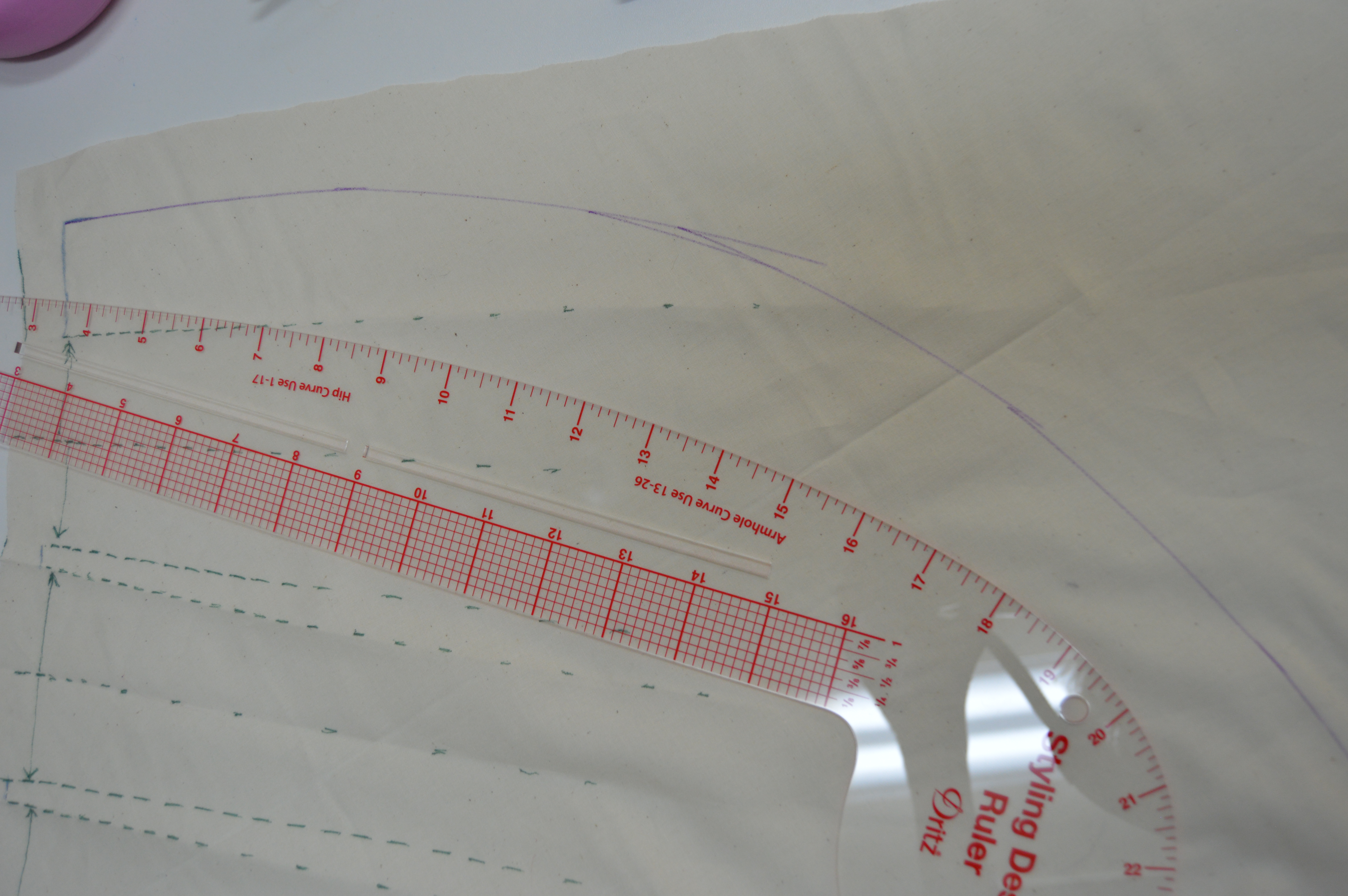
Remove all the pins from the pleats and lay the fabric flat. I now want to cut a smooth curve along the left edge. Using a drafting curve create a smooth curve from the hem up to the mark I previously placed at the left side seam. The mark was to ensure that the pleat underlay was covered by the last fold.
DSC_0410

Finished drape. The irregular edge is your guide to reforming the pleats so be sure to cut it accurately when you cut your fashion fabric.

DSC_0411

Return the section to the dress form and pin in place. Check that everything lines up and you are happy with the final look.

DSC_0413

I decided to create a steeper curve along the left edge.

DSC_0414

DSC_0415

The remainder of the skirt is draped as a simple straight or pencil skirt starting at the right side seam, around the back, past the left side seam to the center front. Don’t forget that this still needs to be sewn up and fitted on the wearer’s body. The closer the form is to the body shape, the less altering will be required. If you decide to do much draping, then a form which mimics your body will save hours of work.

I hope this has made the draping process clearer. There are many ways to approach draping but the more you do it the faster and more adept you will become. It will also give you a clearer understanding of with fabric will and won’t do and you will be better able to judge if a particular fabric will work in the design you have chosen. Have fun!

Lace

Working With Ribbon Lace

September and October were filled with nonstop sewing and I’m happy to have time now to get back to writing. Lace dominated and here is another gown created for the winter ballet and opera season in New York. My client is petite and has difficulty finding evening gowns that don’t overwhelm her slim shape. She spied this lace in my studio and we designed a gown to compliment her figure.

Ana

The underskirt is silk taffeta draped into a half-circle skirt. The pattern was split into thirds; two seams at side fronts and one seam at center back. Placing the grain line down the center of the skirt sections caused the skirt to drape evenly all around.
Taffeta Layout

The bodice lining and underlining were cut from silk crepe de chine. The underlayers ready for lace and tulle.
DSC_0355
The bodice is a simple, waist length top, 3/4 length sleeves and opens down the center back. The lace is underlined with silk tulle. Seam lines thread traced with generous seam allowances. The pink thread is the original seam line; the blue is alterations after fitting.
DSC_0337
Press the seams only within the seam allowance to avoid crushing the ribbon.
DSC_0334
Trim lace seam allowances only, leaving the silk tulle wide enough to fold over twice and bind the seam edges.
DSC_0340
The back closes with tiny buttons covered with the silk taffeta and elastic button looping. I use size 16 tufted-back button blanks and a Handy button press.

DSC_0352

DSC_0351

A narrow stand-up collar finishes the neck edge. The collar is crepe de chine and interfaced with medium weight iron-on weft interfacing. I wanted to use the scalloped lace edge along the top but felt  the scallops were too deep and extended too high along the neck.

DSC_0344 Problem solved by hand gathering the scallop tops to create a less pronounced curve.

DSC_0346

The lace edge was then steamed to follow collar curve.

DSC_0345

Completed lace collar is tacked on from the wrong side.

DSC_0349

Completed collar.

DSC_0366 Looks good but I felt the neckline seam needed a little camouflage. A common technique in couture is to deconstruct and manipulate the fabric. I removed a long length of the ribbon from the lace, hand gathered the edges together to create a double sided band, and applied it over the neckline seam.

DSC_0367

Here is a closeup of the additional ribbon along the seam.

DSC_0372

Next was the tulle skirt. I used a soft finish silk tulle which would drape better than the stiffer version. Fortunately this stuff is available in extra wide widths so the skirt could be cut with only side seams. Using a circular skirt would also give fullness at the hem and allow the waistline to have a slimmer look. I felt a full, gathered skirt would overwhelm this figure.

This is the same design technique used for a bridal gown skirt, also for a slim, petite figure.

Kathleen GownBridal Gown Back

I cut four circles of silk tulle 98 inches in diameter. An inner circle with a diameter of about 4.25 inches created the waist seam. Two circles sewn together at the sides created the top tulle layer; the other two circles were for the under layer of tulle. Slit both layers along the center back for the zipper opening.

Tulle Skirt Layout

Baste the two layers of tulle together along the top edge. I had calculated the finished length of the gown before cutting but needed to allow for final tweaking of the length. The length was adjusted by raising the waistline seam, NOT recutting the bottom edge which would have been over 12 yards and taken forever! Notice I use safety pins for fitting to avoid snagging the delicate fabrics while getting the garment on and off.

DSC_0364

The tulle is hand sewn to the base layer; lace bodice flipped down and tacked and bodice lining tacked along side seams and upper edges.

Finished Ribbon Gown

Lace

French Chantilly Lace/ Layout and Pattern Matching

DSC_0272DSC_0264DSC_0259
This strapless cocktail dress presented some interesting construction and layout techniques unique to lace. The hem is lower in the back and so the usual way of laying out a skirt with the hem following the finished lace edge doesn’t work here. Also the neckline is edged with a scalloped border. The right and left sides are mirror imaged. Picky details but never seen outside of couture workmanship.

I start a project like this by studying the lace pattern carefully and noting where and how the motifs repeat. This lace is a fine French Chantilly with a double galloon edge, meaning there are scallops on both edges.
DSC_0239
The lace is laid out with a scalloped edge running the length of my long cutting table. This shows the pattern repeating vertically every 11 inches. Note the top of the swirl at the end of the ruler and again at the 11 inch mark. Also notice that the same swirl is reversed at 5.5 inches. If you’ve ever worked with upholstery/drapery fabrics you’re familiar with the term “half drop match.” The pattern repeats in some form halfway between the full match.

Probably the easiest way to illustrate the entire dress layout is this:

Layout
Starting with the corrected toile, position the front piece at the far right hand edge with the hem along the scalloped edge. You will have already determined the finished length. I also trimmed the scalloped edge along the entire length, cutting around the motifs. Since back hem was longer than the front, the other pattern sections were moved upwards a full pattern repeat. The waistline was used as a reference point and was also positioned parallel to the lower edge. Now for the interesting part.

At the half drop line (halfway between pattern repeats) the pattern mirror imaged. On this diagram I’ve illustrated this with red C’s. Notice how the C’s flip. The easiest way to get perfect matching is to cut the left (or right side) first, flip the lace piece and lay it down matching the pattern motifs.
DSC_0240
Perfectly mirrored back sections.
DSC_0241
My muslin toile is folded or cut along the seam line, so matching is easy. I fold the seam allowances under and check that the seam doesn’t fall along an unwanted pattern placement. Here I will shift the piece over to avoid a prominent double “fern leaf like pattern” along the seam line.
DSC_0237
The dress is constructed of silk crepe de chine with silk organza underlining. The lace is backed with a layer of silk tulle. That means the dress has four layers: Chantilly lace, silk tulle, crepe de chine and silk organza. They are basted together, seams lines thread traced, and then treated as one layer. I frequently use silk tulle as backing for lace. It’s wonderful to work with and almost adheres itself to the lace. I think it softens the contrast between the lace and silk underlayers.
DSC_0269
Silk tulle comes in black, white and ivory but I’ve successfully dyed it when needed. Nylon tulle is NOT the same. Unlike silk tulle, the nylon version fights you all the way. It doesn’t behave and insists on doing its own thing.
Some advocate using silk organza as backing for lace, but I find it too opaque and doesn’t produce the effect I want. Here is the Chantilly lace with no underlay, silk tulle, and organza.
DSC_0267DSC_0268
Try different materials under your lace and see which produces the effect you like.

Sew major seams through all layers. I hem the crepe de chine/organza layer before finishing the seams. Working with only the lace layer, hand applique the hem border following the motifs. I found silk thread blended in best.

Lace for hem edge trimmed along motifs:

DSC_0261

DSC_0248
Trim away the excess lace underneath the appliqued edge and tack it to the silk tulle.
DSC_0253
The neckline trim is done the same way except trim closer to the scallops so the trim is narrower and follows the shaped edge easier.
DSC_0258
The lining is the same crepe de chine. I fused a high quality weft interfacing to the hip line and added boning for support. This will be worn over a foundation garment, so heavy boning wasn’t needed. A ribbon waistband keeps the dress in place and prevents it from slipping down.
DSC_0254

DSC_0255
Perfectly matched seam with invisible zip.
DSC_0266
If you noticed at the beginning of this post, the photo of the front neck shows the center front as about 3/8 inch off center. This was done to correct for one hip being lower than the other. The toile had a definite right and left side. The pattern pieces are shaped differently but the garment looks symmetrical when worn. The dress form was wearing bust pads and a spandex tank; explains the strange undergarments.

Wedding Gowns

The Wedding Gown: Tying up Loose Ends

A wedding gown isn’t complete without bustling. Otherwise the skirt drags on the ground during the reception, getting dirty and damaged, as well as a tripping hazard to the bride, groom and guests.

As this gown had no embellishment on the skirt, I was limited to placing the pickup points at the seam lines. If you have a gown covered with lace, any hooks, loops or buttons can usually be hidden. The bride, her mom, and I all felt it would be a shame to ruin the sleek surface of this gown with any kind of fastening device. We also chose an underbustle, rather than an overbustle. The difference is that an underbustle, or French bustle, has fastenings, usually sets of ribbons, on the underside which are tied together and hold the skirt up. Underbustling resulted in poufs of fabrics we thought looked liked soft clouds.

The difficulty with bustling is that every gown is unique. While there are some basic principles, most of the time it is a trial and error process. Check out Mrs. Mole’s blog for her bustling adventures.

Here is a diagram of what was worked out with this dress:

Scan0001
Sorry about the poor image. The letters are also reversed. I’m working with a new computer and don’t have image editing software installed yet, so cropping images isn’t working. The image cropping on word press isn’t working either and the scanner reversed the letters, but I hope you will be able to follow.

Pastel silk ribbons are attached on the underside of the skirt, catching the seam allowances of all layers. I color code so that it’s hard to mess up. Points A and B are one color (say pastel pink), points C and D are blue, points E and F are yellow and so on. I find that silk ribbon is strong and also has a texture that poly ribbon doesn’t. Poly ribbon tends to slip and the knots come undone. Silk ribbon tends to stay tied.  We also do a trial with the maid of honor (or whoever will be doing this) so she has practiced before doing it solo.

The skirt at center back was 20 inches too long, so the distance from A to B is 20 inches. That brings the center back up to floor length. Next C and D are tied together, E and F together. We all felt the bustle looked better if it was dragged towards the center back so an additional ribbon was attached at point G (above A) and worked like a large swing tack to prevent the bustle from falling too far forwards.

The small amount of excess length at the side seams was controlled by attaching G to H and I to J.

Sounds easy but it does take some time and trials to get the lengths right.

Cleaning and storing:

The silk dress was cleaned by a local cleaner. Lace top, dress and veil were taken to The Textile Conservation Workshop for conservation packing.

Conservation Workshop
This is the same workshop which dated and cleaned the lace pieces before I began working. They are experts in the field of textiles and with this fragile lace, the bride wanted to do everything possible to preserve it. Notice the large flat soaking trays where pieces can be gently soaked. There is a large drying screen which allows fabrics to be laid flat to dry and water drains preventing further stains; no hanging which might further damage a delicate piece.

What a fascinating project this was!

View More: http://nicolerochellephotography.pass.us/whitehead

Wedding Gowns

A Finished Gown!

Next step is the hem. At this point, the net underskirt is hand basted in place and will be removed to made hemming easier. Some sources advise a narrow hem for 4 ply silk crepe but in a skirt this luxurious I chose to use a horsehair interfaced 3 inch wide hem in the center front and two side front sections of the gown. The side back and center back sections were interfaced with bias strips of silk organza. The hem width tapered from 3 inches at the side seams to 1.5 inches at the center back. The narrower hem width allowed the fabric to be eased in along the curved edge of the train.

DSC_0232

Now, with the gown completed, I hand sewed the net petticoat to the bottom of the corslet. Imagine wrestling all this to the sewing machine! There are times it’s just easier to do things by hand.

Now for the lace overblouse. I created a pattern by draping and manipulated the waistline darts into the bust dart and back side seam to avoid disrupting the lace pattern along the hem.

Here is a section of lace. The cat (NOT MINE, thank goodness), chewed one edge, but I was able to work around it.

DSC_0576

DSC_0131
How do you cut into 200 year old irreplaceable lace? VERY carefully, allowing generous seam allowances and using a muslin pattern which has been fitted over the gown.

DSC_0133

Seam lines are traced with heavy cotton thread as a lighter weight thread pulls out of the lace too easily.

DSC_0135

The buttons have been covered with 4 ply silk from dress scraps so they will match the gown perfectly.

The lace is backed with silk tulle and the two layers treated as one, just as when underlining.

After sewing the seams I trim all layers except one layer of tulle to 1/4 inch. Fold the raw edge of the tulle over and hand sew, binding the seam as you would do a Hong Kong finish.

DSC_0143

Elastic looping finishes the back.

DSC_0139

To finish the neck edge, I discovered two edges of the lace piece had hand appliqued trim. I carefully clipped the stitches and was left with a length of perfectly matching lace trim. This was simply hand appliqued back in place along the neckline.DSC_0575

View More: http://nicolerochellephotography.pass.us/whitehead

Last item was the veil. Real silk tulle veils are luxurious and pricy but since the bride wanted a shorter length, it seemed a shame to stick a length of polyester net on her head. The edge of the veil would be finished with a narrow silk ribbon. Mokuba has exquisite ribbons and I found a shade of ivory which matched the gown. I had planned on attaching it using fine cotton thread and a fine double needle in the machine. Think again! The ribbon was so soft and the tulle so fine I had a balled up mess. Thank goodness it was on the test sample. Another reason to test, test, test your techniques. You never know when disaster will strike.

The only solution: hand sewing.
tDSC_0205DSC_0202
It actually went faster than anticipated and did allow me a great deal of control over the tension of the ribbon on the tulle. Working over a black surface made life easier also.

After the ribbon was sewn along each edge using 80 weight cotton thread, trim carefully along the ribbon edge.

The upper edge of the tulle was simply gathered onto a comb and stitched. An heirloom pin served as the headpiece.

DSC_0229

Finished !

View More: http://nicolerochellephotography.pass.us/whitehead

View from the back, highlighting the luxurious drape of the heavy silk.

gown back in church

Wedding Gowns

Wedding Gown Construction

Here’s a sneak preview of the work in progress. The hem is pinned and basted. The major seams have been machine sewn. All inner support layers are basted in place as they will be removed so each component can be worked on separately.

Front View

DSC_0210

Armed with a fitted muslin, its finally time to cut the silk fabrics. I hand basted the outer 4 ply silk crepe to the charmeuse underlining. There was too much show through even with the two layers, so a second underlining layer of cotton was added. 4 ply crepe does hang out, so the gown was hand basted together and allowed to hang on the dress form for a couple of days. Any pulling of the layers was smoothed out by removing the basting and allowing the layers to fall naturally before machine stitching. View of the inside.

DSC_0226

Notice how the princess seams are pressed. I find that pressing most of the layers towards the center front rather than pressing the entire seam open gives a cleaner line over the bust. The second layer of cotton underlining has been trimmed to the stitching line. There is also a layer of fusible weft interfacing which stops at the waistline. This gives the upper bodice enough body to support the weight of this full, heavy skirt. The straps are just ribbons pinned in place to help support the dress on the form until the inner corslet is attached. To all my readers who alter gowns: don’t you LOVE those big seam allowances!

The corslet fit well except there was a tiny bit too much fabric at the front seams. Even though this bride is small busted and didn’t need a tremendous amount of support, we agreed that adding spiral steel boning in the middle of the side front improved the shape.

DSC_0213

Pattern instructions usually have you stitch the gown and corslet right sides together and turn. I find this method really doesn’t work too well. Unless you are working with very thin fabrics, the gown layer is slightly larger than the corslet. Also the seam, even if understitched, tends to roll and reveal the underside.

I cut the corslet about 1/8 inch below the finished edge. I fuse a 2 inch wide strip of stiff cotton interfacing cut on the straight grain along the upper edge. This is cut to correspond to each section.  I also add a row of fusible 1/4 inch stay tape to further stabilize the top edge. This tape is pulled tight across the top of the bust so the corslet hugs the upper chest wall. How many formal gowns have we all seen where this gaps open?

DSC_0214

Next I attach a bra which is stitched in place at the side seams. If the gown is backless or lowcut, the back of the bra can be cut away. We chose to leave the bra back in place as it didn’t show through and felt secure. The center front of the bra floats inside a loose ribbon loop. If this ribbon is too tight, the center front is pulled inwards, creating an unattractive hollow on the finished side. I tend not to use sewn in cups. They move with the dress, creating a “floating boob” effect.

DSC_0218

The back closure has spiral steel boning along both sides and a fabric underlap to prevent the hooks from digging into the skin.

DSC_0220

The gown is in three major sections: The silk gown, the corslet, and the petticoat. I avoid stitching these together until each section is totally completed. It’s so much easier to work on one section at a time. It saves wear and tear on the silk and 4 ply crepe tends to snag easily (usually at the center front where its most visible).

Gown is fitted and complete; corslet fits perfectly and is completed. I attach them in the following way: Trim the gown allowing between an inch and two inches to turn over at the top edge. Grade and trim all seams to reduce bulk as much as possible. I bind the top edge with silk tulle. Silk tulle is amazing stuff. It’s soft, weightless, stretches like bias tape, and stays where you put it. Nylon tulle is not the same thing. It will fight you all the way!

DSC_0223

Fell stitch in place. Sewing this top edge by hand allows you to perfectly control the layers.

Next: hemming, attaching petticoat, lace overblouse and veil. I need a break!

Wedding Gowns

The Wedding Gown: Creating the Understructure

Although wedding gowns can look complicated, the basic lines are often fairly simple. For this dress McCall’s M4776 (not sure if it’s still in print but there are loads of similar patterns) provided a starting point.

DSC_0136
I find it easier to create the understructure of the gown first. That way you can have it on the dress form and get a clear idea of how the dress will actually look. The fullness also dramatically affects the hem length. I used only the four main pieces and created the boned corslet and petticoat from them.
Master Pattern
Here is an illustration of the basic pattern with my additions. The corslet pattern is shown in red. It extends 4 inches down from the waist and will be sewn with slightly (about 1/16 inch) larger seams as it needs to be skin tight. For fitting I copied the corslet shape in cotton drill fabric and padded a dress form ( the junky adjustable kind) to mimic the bride’s shape. Since this dress is only fitted through the upper bodice, no need for a fully fitted custom shape.

I used white cotton coutil. If you’ve never used this before it works wonderfully for a tight fitting support garment. It presses easily and flexes just enough to mold to the body. It’s sturdy and heavy enough to support the boning which will be added to each seam. The cotton fiber is also cooler to wear than a synthetic. The boning channels are sewn along each seam and at center front. Flexible steel bones will be inserted into the back and side seams; spiral steel into the princess seams over the bust and center front. The gown flares out below the waist so I decided to end the boning at the waist. Since this bride is not full busted, I’ll decide whether or not the bodice needs additional boning after a fitting. The waist has been thread traced to use as a reference during fitting and also as a guide for the ribbon waistband which will hold this whole thing up.
DSC_0118
Rather than make or buy a separate petticoat I chose to integrate one into the dress so it could hang from below the waist. The pattern for this was drafted 4 inches lower than the waist (it will ultimately be stitched to the bottom of the corslet) and two inches narrower at the bottom than the outer skirt. It is about 5 inches shorter than the finished hem. The petticoat is shown in green. By removing two inches from each skirt seam I decreased the circumference 28 inches to allow for the petticoat ruffles.

The petticoat skirt was cut from satin faced silk organza. It’s stiff enough to hold the shape without being heavy. Two lower layers of stiff nylon netting were gathered and sewn to the petticoat base. I cut the netting 30 inches wide and folded it lengthwise (no scratchy exposed edges) and gathered it  4:1. An easy way to keep the gathering even is to mark every 18 inches on the netting. Zigzag over a length of heavy thread and pull up gathers so every mark is 4.5 inches apart. The two ruffles were attached along the dotted purple lines.

To soften the outer petticoat layer I used soft nylon tulle and gathered it 10:1. It was attached along the uppermost purple line. Two inch wide nylon horsehair braid keeps the hem of the organza layer full.  3/4 inch horsehair braid is topstitched along the top edges of the lower ruffles. If you want to keep your sanity while sewing this, leave the center back seam open so the piece can lay flat. Close it and lap the ends of the tulle and braid as a last step.

DSC_0117
A closer view of the underskirt layers.
DSC_0119
DSC_0120
Here is the muslin toile draped over the underlayer. Notice how I’ve made a slight adjustment to the side seams under the arm. The neckline has also been shaped. Having a muslin also allows me to determine a final hem length, play with bustling options and minimizes handling the silk outer fabrics.

DSC_0121
I keep the corslet and petticoat separate as long as possible. The corslet will be sewn into the finished gown first. The petticoat layer will be hand sewn into the dress once all else is complete; SO much easier than wrestling with mountains of poufy fabric at the machine.

Next step is construction of the outer silk gown!

Tailoring

Vogue 1440 Finished

I hate having unfinished projects cluttering up the workspace, so before getting to work on the bridal gown, I needed to finish Vogue 1440.  I left off with a fitted shell but no sleeves. I have given up on the sleeve shape of most patterns and find I get much better results with my own draft.

DSC_0048
The cap has less ease in the back and more rounded at the front to accommodate the ball of the shoulder. I also raised the underarm and decreased the overall width.
Here is the muslin showing that most of the easing is in the front.
DSC_0051
I also shaved an inch and a half off the collar width
DSC_0056
The sleeve was stretched and steamed into shape.
DSC_0065
before setting the sleeve, snug the back of the armhole which creates a pocket for the shoulder blade.
DSC_0069
The collar back was too floppy and benefited from a felt collar stand. This was interfaced with hair canvas, pad stitched and applied to the collar back.
DSC_0070
To maintain the soft drape of the front I stay stitched 3/4 inch from the edge and fringed the cut edge.
DSC_0072
Most trims are far too stiff and would have destroyed the drape of the front section. Black chenille yarn was soft enough to apply to both front and back sides without altering the drape of the wool boucle. I chose to omit the seam piping. The boucle is underlined with silk organza and lined with silk crepe de chine.
DSC_0079
DSC_0077
DSC_0078

Wedding Gowns

Follow the Birth of a Custom Wedding Gown

I have an exciting project in the works and finally have enough pics to share it. I’m creating a gown for a July wedding and will be posting the progress, both as a record for myself as well as a memento for the bride.

The focal point of this gown is absolutely spectacular handmade Point de Venise lace which has spent the last couple of months in Connecticut being cleaned. Hard to believe this lace was created with a single needle and sewn entirely by hand. We were told by the restorers that the lace was likely made during the 1820’s!DSC_0572
Closeup of the detail
DSC_0575
There are two matching pieces. One is rectangular with a scalloped border and the other this shape.
DSC_0576
The dress will be a simple strapless gown with train which will be bustled up for the reception. The lace will be a separate top hemmed at the midriff with short sleeves. Buttons covered with dress fabric will close the top at center back. The fitting muslin with lace draped to approximate the top.
DSC_0578
A gown with no embellishment calls for luxury fabrics. I met the bride and her mom at B&J Fabrics in NYC and set up a work station at one of the long tables overlooking 7th Ave. The window provided loads of natural light for color matching. Antique lace is never white and and we needed a LARGE selection of fabrics to choose from. The staff at B&J were incredibly helpful, pulling roll after roll of various shades of ivories. We finally decided on a wonderfully drapey 4 ply ivory silk crepe which will be underlined with white double faced silk charmeuse. The white underlining brightened up the ivory just enough to compliment the lace.
Fabrics 1
The lace will be backed with ivory silk tulle which will provide just enough stability for it to hold its shape nicely. The same silk tulle will be used for a short veil.
Fabrics 2
Veil 2
The first step is now to create the gown’s under structure of a boned corset and attached petticoat. I’ll tackle that in the next installment.

Tailoring

Vogue V1440: Tweaking the Fit

DSC_0046
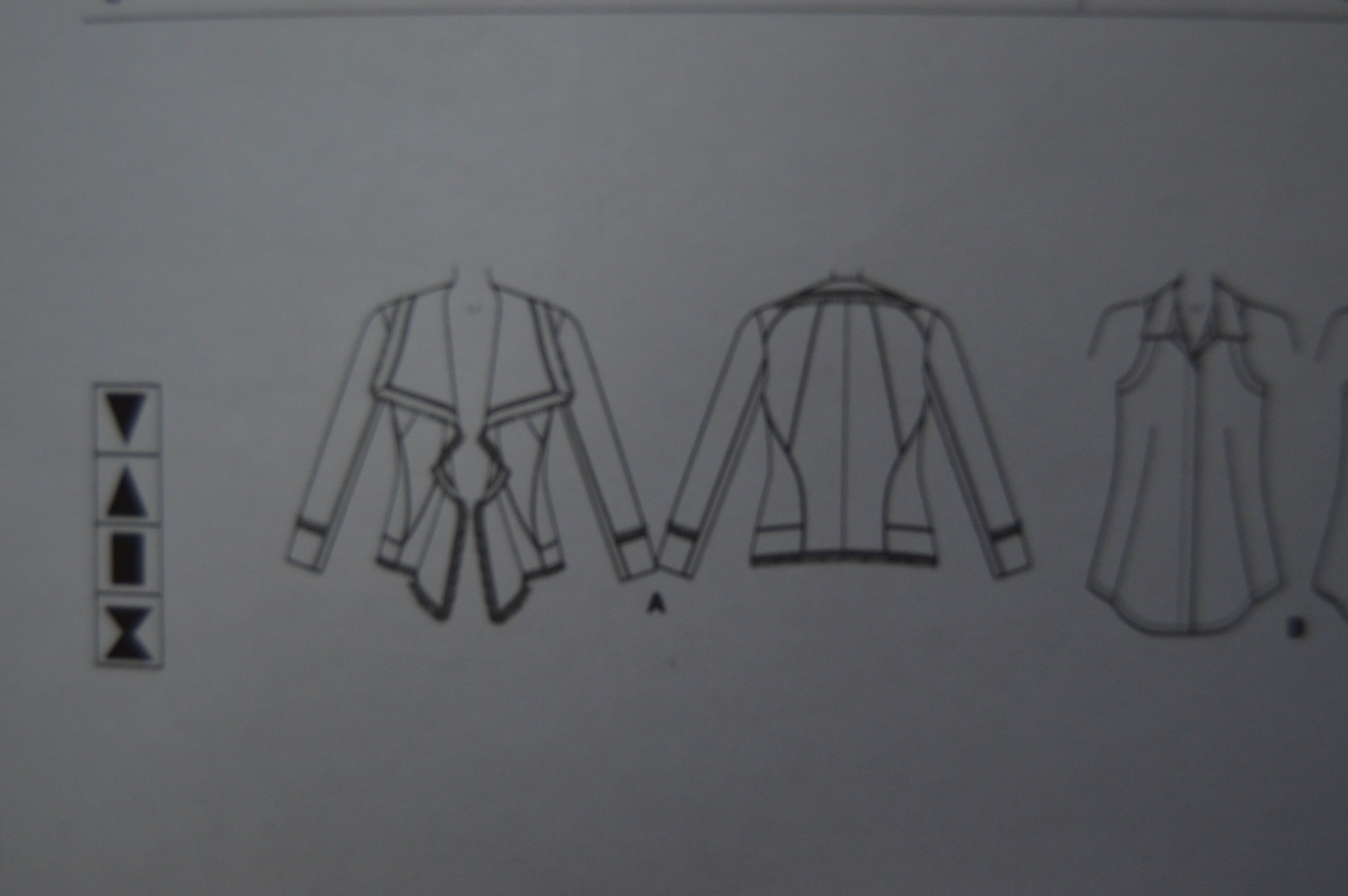
I came across this Donna Karan Vogue pattern. The jacket looked like a fun, easy to wear, garment. I also loved the interesting style lines and curved seaming.
DSC_0047
First a word about size selection. I’ve found that it works much better to select your pattern size by your high bust measurement, NOT the full bust. I measure 32″ high bust and 34″ full bust. That would mean I should cut a size 12. Size 12’s are ridiculously huge on me. The neckline gaps open and the shoulders are HUGE. I go down two sizes and cut a size 8, which is 31.5 bust. That fits me much better in the neck, armholes, and shoulders, areas which are much more difficult to alter than side seams. I’ve found that the high bust is a truer measure of your bone structure and will give a better fit. You may need to alter for a full bust and/or fat tissue, but those changes are easier than the neck/shoulder areas.
Here is my first muslin, cut exactly according to the pattern. It’s shown on my form which is an exact duplicate of my shape.
DSC_0033
Here’s the back view.
DSC_0032
There is a huge amount of ease at the underarm along the side seam. In order for the side seams to match up the front piece needs to flare out away from the body. Not the look I’m after.
DSC_0029

The side seam also flares out at the hem much more than I would like. The pattern line drawing looks to me like a fairly slim fitting jacket. I have a long torso and the waist also needs to be lengthened by 1 and 3/8 inches.
Here’s a view of the original on the left side and the altered version on the right side.
DSC_0034
DSC_0036

Changes to the pattern. The red lines are the new seam lines. I’ve raised the underarm and reshaped the armseye. I’ve also removed fabric from the collar at both the neck and front edge.
DSC_0035
Style tape makes it easier to redraw this seam line. The triangle shaped section has excess pinned out which will be removed in the redraft. I’ve repositioned the bust dart for a smoother fit.
DSC_0028
The altered flat pattern.
DSC_0039
Most of the alterations are along the side seam and armhole. One major change is to reposition the grain line on the triangular shaped piece. I wanted more waist shaping but didn’t want to add additional seam lines to already busy lines. I placed the bottom and back edges of the triangular piece on an almost true bias and the front edge was slightly off grain. Stretch the bottom and back edges while steam ironing.
DSC_0044
How it now conforms to the body curves and shapes the waist better.
DSC_0045
The curved edge along the jacket front will also be steam stretched to hug the body.
The collar and front piece is basically a curved ruffle. Take a tip from Roberta Carr  (her book: Couture:The Art of Fine Sewing)  and do not clip this seam until after it’s sewn and then clip at precise intervals to control the ruffles.
DSC_0042
If you try this pattern pay attention to the fabric choice. A softly draping tweed or loose weave will work best. Anyone else tried this design?